CDISC Dataset-JSON
Category: Clinical-trial dataset exchange
CDISC Dataset-JSON is a JSON transport for tabular research datasets. Convert-Pheno reads Dataset-JSON v1.1 SDTM domains and groups their rows by participant. The checked-in tests cover the documented SDTM domains; more independent studies are needed to exercise vendor and study-specific variations.
USUBJID in memory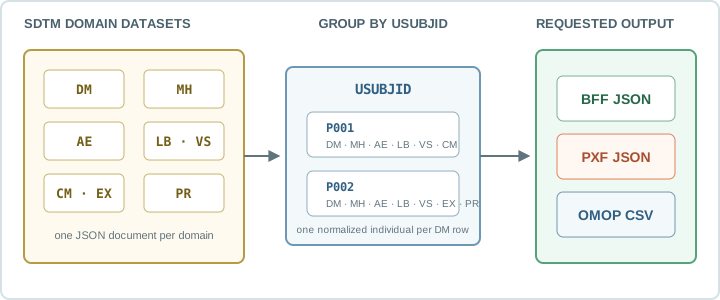
What You Need
Supply one JSON or gzip-compressed JSON document per SDTM domain. The files may be given in any order. The essential requirements are:
- exactly one
DMdataset - one unique
DM.USUBJIDfor each participant USUBJIDin each participant-level domain- one consistent
studyOIDwhen it is present
The structural SDTM mapping is built in. A mapping file is optional and is used only when reviewed terminology enrichment is required.
convert-pheno \
  -idataset-json dm.json ae.json lb.json \
  -obff individuals.json
The same input can produce PXF or OMOP-CDM. See the Dataset-JSON recipes for those commands.
Mapped Content
| SDTM domain | Main converted content |
|---|---|
DM | identifier, sex, ethnicity, geographic origin, birth date, and vital status |
MH, AE | diseases and phenotypic features |
LB, VS | measurements, units, ranges, and dates |
CM, EX, PR | treatments and procedures |
TS | dataset and cohort metadata |
Other participant-level domains remain available under
info.datasetJson.domains. Use --no-source-info to omit that raw copy while
retaining the mapped BFF fields.
For the field-level contract, see Dataset-JSON to BFF.
Terminology
Without extra configuration, term-bearing SDTM values use source-derived
CDISC: identifiers. These preserve the SDTM field and value; they do not
claim an NCIT, SNOMED CT, or LOINC mapping.
To resolve selected values, provide a Mapping V2 file with
source.profile: sdtm. It may contain reviewed direct terms, aliases, or
database queries. Optional Define-XML metadata can also supply supported NCI
identifiers.
For OMOP output, source-derived CDISC: identifiers are not assumed to be
Athena concept codes. The BFF-to-OMOP stage can still resolve a unique active
standard concept from a reviewed identifier, an official Maps to
relationship, or a label in the expected OMOP domain. Otherwise it emits
concept 0. Use a reviewed terminology mapping when the OMOP concepts carry
analytical meaning for the study.
convert-pheno \
  -idataset-json dm.json ae.json \
  --mapping-file sdtm-terminology.yaml \
  --term-audit terminology.tsv \
  -obff individuals.json
The baseline fixture output shows source-derived fallbacks. The terminology-enriched output uses a small reviewed mapping and resolves selected fields to NCIT. Neither is intended as a complete SDTM terminology crosswalk. See Mapping Files and Terminology Search before adapting the example to study data.
Dataset-JSON input is non-streaming. All domain documents and grouped participant records must fit in memory.