CSV
Category: Tabular source format
CSV is a general delimited-text format rather than a clinical data standard. Convert-Pheno interprets project-specific clinical rows through a required mapping file, then writes BFF, PXF, or the supported OMOP-CDM tables.
--term-audit for terminology review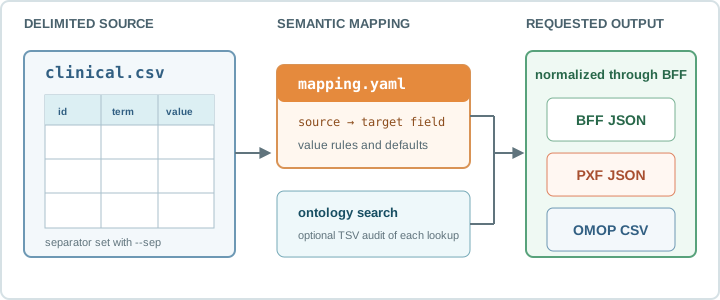
CSV As Input
CSV input is intended for project-specific clinical tables that do not already follow another supported model. A YAML or JSON mapping file is required to connect source columns and values to Beacon individuals fields and, when the source includes specimen records, first-class biosamples.
The default separator is ;. Use --sep when a file uses a comma, tab, or
another delimiter.
Follow the CSV-to-validated-BFF mapping recipe.
It includes a complete Mapping V2 file, terminology auditing, LLM-term checks,
and final validation with bff-tools.
Use CSV conversion recipes for BFF, PXF, OMOP-CDM, and multi-entity BFF commands. Mapping semantics are documented under Mapping Files, with ontology lookup behavior under Terminology Search.
CSV to OMOP-CDM
The CSV-to-OMOP route is a focused, schema-aware ETL path. Convert-Pheno maps each source record to its internal BFF representation and then applies the supported BFF-to-OMOP mapping; users do not create the intermediate BFF file.
OMOP output requires the Athena-OHDSI database selected by --ohdsi-db.
Generated output is limited to the documented tables and fields and must be
reviewed before database loading.
This route does not automatically profile an unfamiliar CSV or make terminology-curation decisions. The mapping file replaces the source-model definition step; it is not a one-for-one implementation of White Rabbit, Rabbit-in-a-Hat, or Usagi.
Output Review
BFF output preserves each source row under info.CSV_columns by default. Use
--no-source-info to omit that copy. Mapping-file routes can map biosamples
through beacon.biosamples.rules and synthesize datasets and cohorts,
with metadata under the corresponding defaults sections.
Tested source, mapping, and reference-output files are indexed in the
t/ fixture guide.