openEHR
Category: EHR interoperability and information modelling
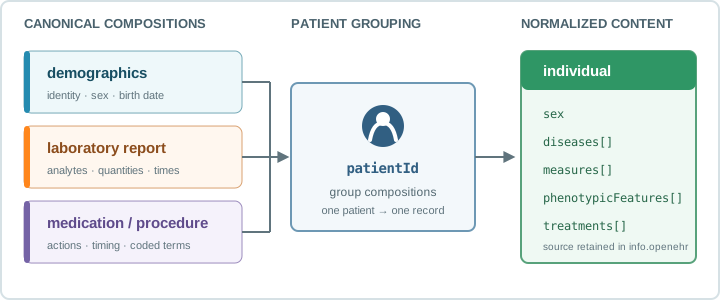
openEHR defines vendor-neutral clinical information models and canonical representations for electronic health records. Convert-Pheno reads an EHRbase-oriented canonical composition profile and groups compositions by patient. Templates and canonical exports from other deployments may require additional mapping work.
What You Need
Convert-Pheno accepts EHRbase-style canonical compositions as JSON or YAML,
including gzip-compressed files. Input can be a patient envelope containing a
compositions array, one raw composition, or multiple files supplied in one
request. The clinical mapping is built in. For entity-aware BFF output, an
optional compact Mapping V2 file
can name the synthesized dataset and cohort.
convert-pheno -iopenehr composition.json \
  -obff individuals.json
Compositions for the same patient become one record. Conversion requires a stable patient identifier and administrative gender. See the openEHR recipes for PXF output.
What Is Converted
| openEHR content | Main BFF target |
|---|---|
| administrative gender | sex |
| problems and diagnoses | diseases |
| laboratory results and body temperature | measures |
| symptom screening | phenotypicFeatures |
| procedures | interventionsOrProcedures |
| medication actions | treatments |
External codes are retained as CURIEs. Uncoded text receives a local
openEHR: identifier when the target term requires both an identifier and a
label. Source compositions are preserved under info.openehr.compositions
for traceability. Use --no-source-info to omit the compositions and
item-level source nodes while retaining mapped fields.
Current Boundaries
The openEHR route currently writes BFF or PXF. It does not directly write OMOP,
CSV, flattened JSON, or JSON-LD, and it does not yet map first-class Beacon
biosamples. Coverage depends on the archetypes and node names represented in
the implemented canonical profile.
For field-level behavior and omissions, see openEHR to BFF.