Cross-Environment Reproducibility
Cross-environment reproducibility checks whether the same CBIcall analysis can recover the same final variant calls across machines and runtime environments. It is separate from truth-set benchmarking, which is covered in GIAB Benchmarking.
To evaluate CBIcall portability and reproducibility, a 1000 Genomes Project WES
sample, HG00103 (SRR1596639), was processed with identical workflow
definitions across four computational environments. The WES sample used the
native Bash GATK 4.6 single-sample workflow on b37 with the
cbicall-germline-resources-v1 resource bundle.
CBIcall also includes a small repository reference sample used by the installation and backend-equivalence checks. That sample is covered in Integration Tests; it is useful for confirming that an installation works before running larger external data.
Compared Runs
| Run label | Environment | Notes |
|---|---|---|
gcloud | Google Cloud Platform VM, Ubuntu 22.04 | Cloud VM run. |
ws5 | x86_64 workstation, Linux Mint 20.3 | Local workstation baseline. |
ws1 | macOS ARM64 workstation running Ubuntu 24.04 in a VM | Heterogeneous CPU architecture. |
hpc | SLURM-managed HPC cluster, x86_64 CentOS Linux 7.9.2009 | Production-style HPC environment. |
All runs were compared with cbicall compare-runs using the final QC VCF
fingerprints recorded in each run-report.json. The primary evidence is the
CBIcall text and HTML comparison report, not the optional MultiQC export.
Result
The final VCF contained 23,562 variant records: 19,578 PASS records
and 3,984 non-PASS records. All four runs produced identical final variant
calls under the CBIcall call-level VCF fingerprint.
The ws5, hpc, and gcloud runs also matched under the stricter full-record
fingerprint. The ARM ws1 run differed only under the strict-record
fingerprint. Manual inspection localized this to a minor numeric difference in
non-call fields for one record (3:196281208 T>C), consistent with
environment-level numerical drift rather than a changed variant call.
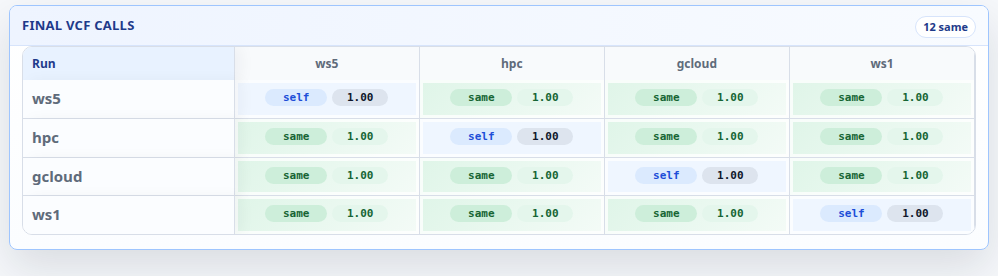
Final VCF calls NxN heatmap from compare-runs.html; all 23,562 call-level records, including PASS and non-PASS records, match across every environment pair.
| Comparison target | VCF calls fingerprint | VCF strict records fingerprint | Interpretation |
|---|---|---|---|
ws5 baseline | 727f877de6ec...0a26a976 | a659e0105d8b...4a5539c0 | Baseline. |
hpc | 727f877de6ec...0a26a976 | a659e0105d8b...4a5539c0 | Matches baseline at call and strict-record level. |
gcloud | 727f877de6ec...0a26a976 | a659e0105d8b...4a5539c0 | Matches baseline at call and strict-record level. |
ws1 | 727f877de6ec...0a26a976 | 5c03b2a73c25...7407487e | Call-equivalent to baseline; strict-record-only numeric drift. |
Call-level versus strict VCF hashes
CBIcall records three complementary VCF checks because different questions need different levels of sensitivity.
| Fingerprint | Fields hashed | Example of change detected | Typical interpretation |
|---|---|---|---|
sample order | Ordered sample names from columns 10 onward in the VCF #CHROM header. | A sample is renamed, added, removed, or reordered. | The compared VCFs do not describe the same ordered sample set. Check this before interpreting call-level agreement. |
calls | CHROM, POS, REF, ALT, FILTER, and each sample GT in VCF sample order, across all final VCF records. | A variant becomes filtered instead of PASS, a genotype changes from 0/1 to 0/0, or a site appears/disappears. | Final reported calls changed. This is the primary reproducibility check for WES/WGS outputs. Because FILTER is hashed, PASS and non-PASS records are both audited. |
strict records | Complete sorted non-header VCF records, including QUAL, INFO, all FORMAT fields, PL, annotations, and other numeric fields. | Same PASS and GT, but QUAL shifts from 2267.64 to 2266.64, or PL shifts from 2275,0,3196 to 2274,0,3196. | The full VCF record changed. This can detect small numerical drift even when the final call is unchanged. |
The sample-order check was added without changing the call-level or strict-record hash definitions. The cross-environment hashes reported above therefore remain directly comparable with the original analysis.
In this validation, ws1 and ws5 had the same FILTER=PASS and GT=0/1 for
3:196281208 T>C, so the calls hash matched. The strict hash changed because
only non-call numeric fields shifted.
Evidence Artifacts
| Artifact | Use |
|---|---|
compare-runs.txt | Canonical text audit report for archiving and diffing. |
compare-runs.html | Static browser report; this validation uses the Final VCF calls heatmap plus the VCF calls / strict records rows. |
compare-runs_mqc/ | Optional MultiQC custom-content export for projects that already aggregate QC with MultiQC. It is not the primary evidence artifact for this validation. |
The evidence bundle can be regenerated from collected run directories:
cbicall compare-runs \
  ws5/HG00103/SRR1596639/cbicall_bash_gatk-4.6_wes_single_b37_178178909641565/ \
  hpc/HG00103/SRR1596639/cbicall_bash_gatk-4.6_wes_single_b37_178179425143788/ \
  gcloud/HG00103/SRR1596639/cbicall_bash_gatk-4.6_wes_single_b37_178185765566264/ \
  ws1/HG00103/SRR1596639/cbicall_bash_gatk-4.6_wes_single_b37_178153803413337/ \
  --alias ws5 hpc gcloud ws1 \
  --output compare-runs.txt \
  --html compare-runs.html
Add --multiqc compare-runs_mqc only if the comparison needs to be included in
a larger MultiQC project report. For interpreting this reproducibility check,
use compare-runs.txt and compare-runs.html.