Beacon v2 Models
BFF stands for Beacon Friendly Format. The BFF is a data exchange format composed of 7 JSON files. These files correspond to the 7 entities of the Beacon v2 Models.
individuals.json array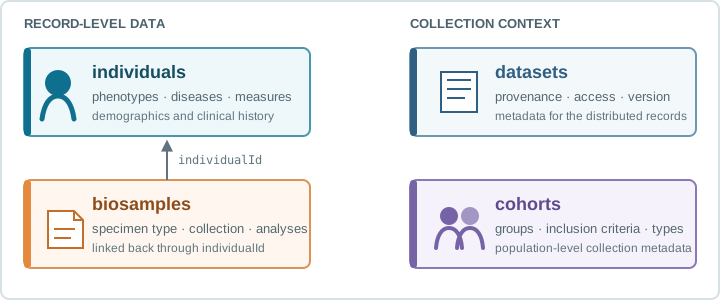
individuals collection.Of the seven entities (a.k.a., entry types) in the Beacon v2 Models, individuals is typically the only one that contains phenotypic data (represented at record-level granularity).
Pheno-Ranker accepts data from the individuals entity, serialized in BFF format (individuals.json).
Browsing BFF JSON data
Run This Format
- Desktop
- CLI
- Select New analysis, then choose cohort or patient mode.
- Open User files and select
individuals.jsonas the reference cohort. - In patient mode, also select the target record.
- Select Run analysis.
No configuration file is required. See the Desktop guide for the visual workflow.
For cohort mode:
pheno-ranker -r individuals.json
For patient mode:
pheno-ranker -r individuals.json -t patient.json
The commands create matrix.txt and rank.txt, respectively. Continue with
Cohort Mode, Patient Mode, or the full CLI Reference.
How are BFF arrays compared?
For first-level BFF arrays such as diseases, exposures, interventionsOrProcedures, measures, phenotypicFeatures, and treatments, Pheno-Ranker replaces numeric array indexes with semantic identifiers configured in identity_paths.
From v1.08 onward, users do not need to transpose or manually rewrite nested BFF arrays. Nested arrays are canonicalized automatically from their meaningful content, so equivalent nested objects can match even if their order differs between records.